View
some text
Toast Text
Toast Text
How to unite your audience with digital events

Convention, general meeting, training, workshop... These unifying events are essential to strengthen the collective and the commitment. At a time when gatherings are no longer possible, how can we reproduce this energy digitally? How to mobilize, transmit and motivate through screens?
Identify your audience
Who is my digital event for? This is the number one question to ask yourself, just like any face-to-face event and any digital content. Behind the “who” are all the other important questions to ask yourself:
- Who should I reach: what is the platform to deploy?
- What atmosphere corresponds to my audience: what stage/scenography should I choose?
- What are my audience's expectations: what types of content to produce?
Choosing your platform
The container at the service of content. It is essential to reflect and choose the distribution platform at the beginning of the project according to its audience.
Your event only concerns employees. Give priority to the intranet and collaboration platforms (such as Teams) that employees are used to. But be careful to properly assess the robustness of the internal network! Bringing together virtually hundreds or thousands of people connected at the same time, remotely and via VPN, can cause a saturation of the corporate network. There, it is essential to talk to your CIO to know the limits. If it does not offer the necessary resources, solutions exist: ask everyone to connect via their private box or 4G, create two events rather than one in order to split the weight of the connections in two, set up a server dedicated to the flow of the event... etc. Even if the audience is often smaller than outside, the technical dimension is more complex for internal events, do not underestimate it.
Prospects, partners... An identified external audience. Use a solution that you are used to exchanging with externally, again: Teams, Google Meet, Zoom are simple and practical. You can also turn to platform solutions dedicated to webinars that may be relevant if you want more functionalities.
The general public. Paradoxically, the network constraints are less since everyone connects via their personal network. Platforms like Viméo and YouTube offer the possibility of redirecting the video stream easily to social networks (Facebook, Twitter, LinkedIn...) in order to reach as many people as possible.
If your audience is a mix of internal/external/general public. It may be a good idea to use a platform created especially for the event. It will then be personalized and will allow you to collect contact details, statistics and other useful information to analyze the audience reached by your event.
Whatever the audience and the solution chosen, test beforehand one or two weeks before your event to verify that the system is working properly.
Design your staging
Live or delayed. Do you need spontaneous interaction with your audience, for example a question and answer sequence? This is the question to ask yourself when deciding whether your event should be live or not.. If you do not want interaction or if it is limited to a duplex with a few people identified beforehand, live is not essential. The delay gives more flexibility during filming, it is more reassuring for the actors, the editing makes it possible to correct imperfections...
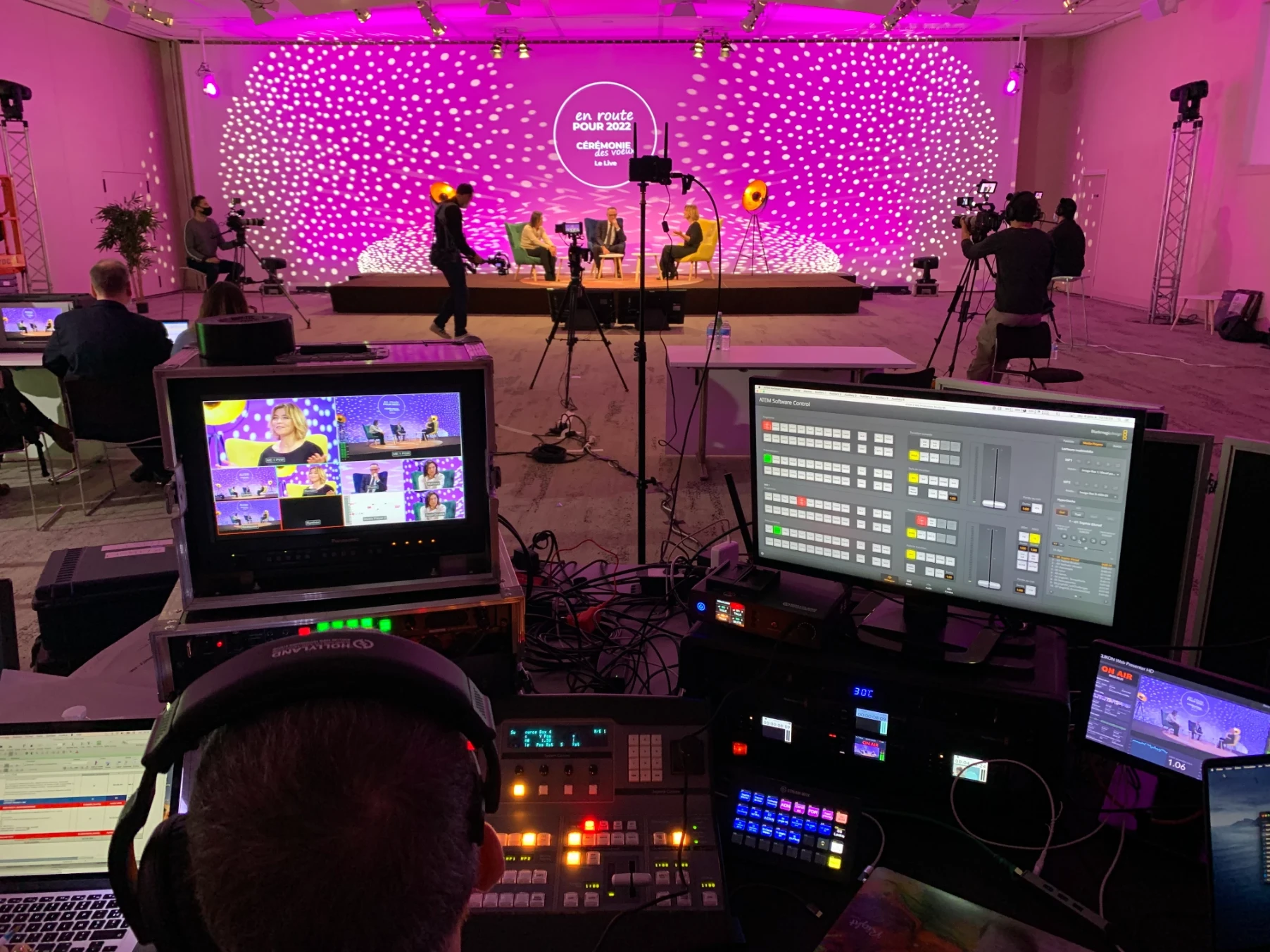
Place/scenography. Statutory, friendly, innovative, reassuring, ambitious... You must qualify your event to define your filming location. It should correspond to the meaning of your event. For a “formal” event (general meeting, board of directors, etc.): choose a place in the spirit of a talk-show TV set with a background in your colors, logoed desks, etc. On the contrary, for more user-friendly formats (debate, webinar, workshop, training...), look for a warmer and cozy place: loft, coworking space... With furniture that matches.
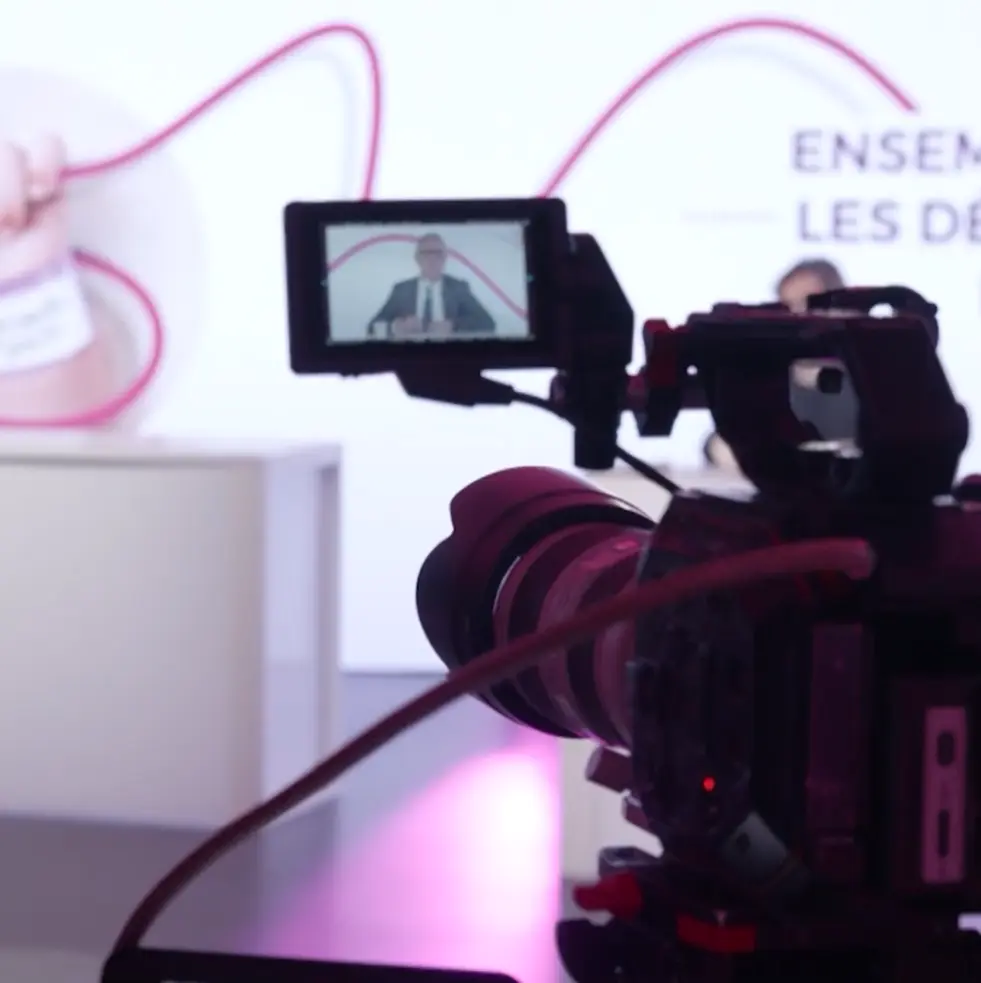
Capture. It's time to talk about capturing your event! If you only gather several dozen spectators for a presentation or training, a simple setup with a cameraman equipped with a 4K camera may suffice. For events with hundreds or thousands of participants, a more ambitious project is required with 2 to 5 cameras depending on the number of people to be filmed (you can of course use more depending on the style of production sought). The alternation of shots creates a professional and aesthetic result that impresses the audience and keeps them focused!
Presenter. To set the pace for an event, there's nothing like a presenter or presenter. He or she sets the tone and creates the dynamics of the program. To value your business, and for Play the conviviality card on internal events, you can choose someone internally. You need someone who is experienced in public speaking; the director of communication often fulfills this role. Do not hesitate to offer him a coach specialized in speaking in front of the cameras, it is reassuring and it allows you to fully master the issues related to audiovisual production. This coach can also support your stakeholders. Second option: leave it up to a professional presenter, he or she will be able to guarantee good rhythm management.
Graphic design. There are the possible screens that can be seen on stage, but also the layout of your program: an opening theme and jingles make your event more dynamic and allow it to be reasoned with the identity of your brand.
Tailor-made content
The right format to get the message across. You need to think about the format that will appeal to your audience. The message is always quite simple to find in the end, it is often the reason that initiated your event. But putting it into shape requires more thought, you have to be daring, make choices and innovate. Don't just replicate the format created for an in-person event. In digital, the viewer is less attentive in front of the screen. The challenge is to create a dynamic, even original format, while maintaining the codes and values of your company. Remember to pace your event, especially if it lasts more than an hour. You can broadcast, throughout it, motion design pellets, reports, duplexes etc.
Delinearize content. For a “big event”, take inspiration from Netflix and streaming in general by offering à la carte content. Instead of having a video lasting several hours during which the attention of your audience will gradually decrease, produce several short programs. Everyone can then consume your content according to their priorities and interests, all at once or several times. And if your event is not very long, it will be better to offer a bonus with a focus on a particular point that you can detail, rather than integrating it into the overall setup, because it would risk making you lose part of the audience.
Engaging your audience. Your digital event must break the solitude of the spectator in front of his screen. To be a federator in digital technology, it is therefore essential to involve your audience and allow them to interact. To do this, it is important to give your audience a voice, either through content produced beforehand (interviews, microwalks, field reports, etc.), or through a live exchange. Plan frequently question and answer sequences on your lives, to allow everyone to focus the subject on a point that interests them, or at least so that they know that they have the opportunity to do so, that they have “their say”.
To be a success, the digital event must integrate the human dimension as much as possible. Taking into account the few parameters we have just mentioned will help you better build a captivating and inspiring program. And then, it's knowing your audience, understanding their expectations, and being able to reach them that will make the difference.
Pour prendre rendez-vous avec nous, ça se passe ici !